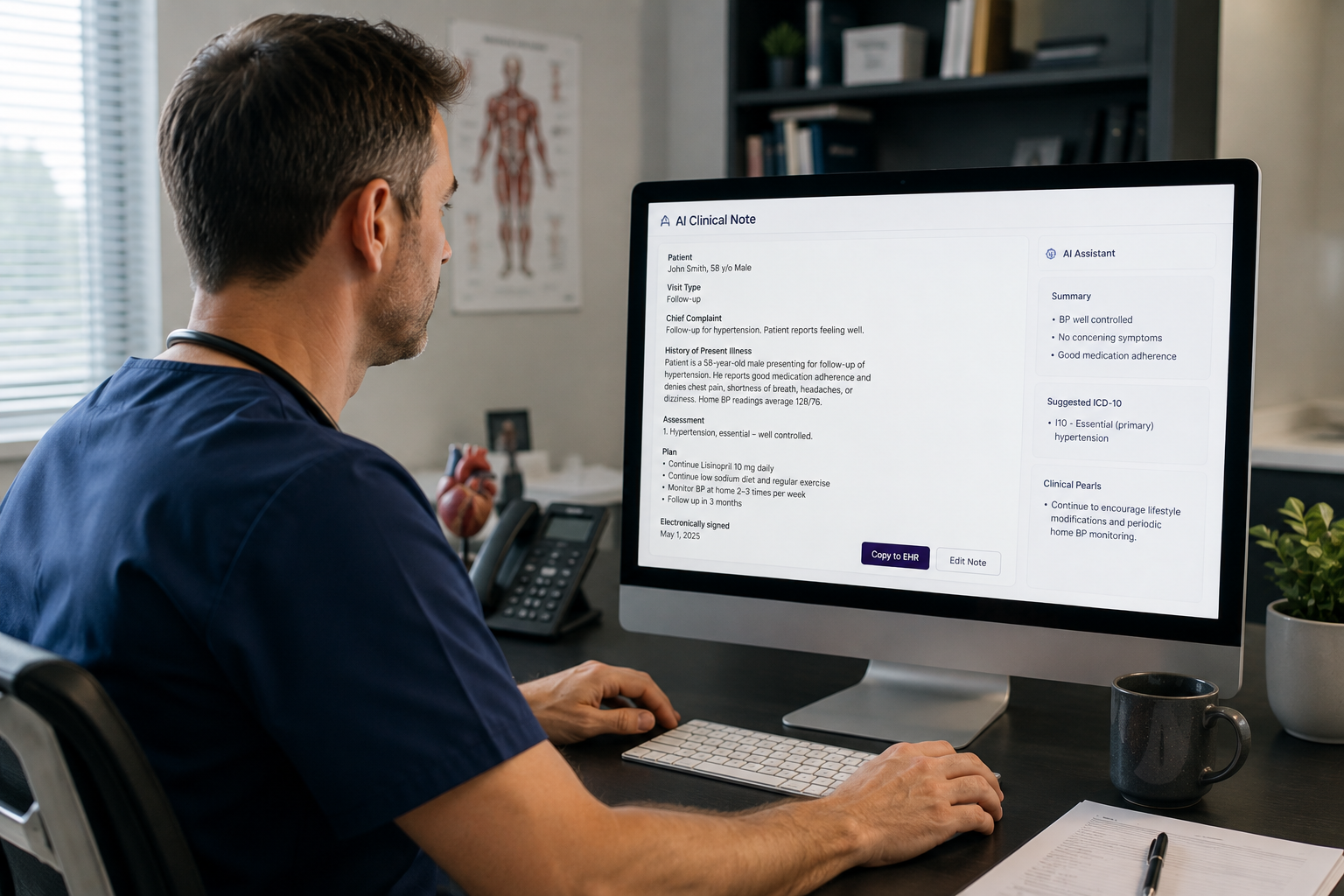

There is a moment most clinicians know well.
The shift is over. You are in your car, or standing at your front door, or already in your kitchen with your coat still on. And somewhere at the back of your mind, the number is sitting there. Charts still open. Notes unfinished. Inbox tasks waiting.
The shift ended. The workday did not.
For physicians, the data on this is not subtle. Physicians spend roughly two hours on EHR work for every one hour of direct patient care, according to research published in the Annals of Internal Medicine. The Medscape 2025 Physician Burnout Report found that 62 percent of physicians who report burnout name bureaucratic tasks and EHR burden as the primary driver. Among nurses and allied health professionals, documentation requirements have expanded in every setting as regulatory and compliance demands have grown.
The system was designed this way. The burden you are absorbing every shift is a structural problem, not a personal productivity failure.
That distinction matters because the advice most clinicians receive (chart faster, use more templates, stay an extra thirty minutes) is aimed at the wrong target. You cannot solve a system problem by becoming more efficient at absorbing it.
What you can do is build specific boundaries inside the system. Here are seven that work in real clinical environments.
What the Charting Tax Actually Costs
I use the term charting tax with the clinicians I coach because it captures something the raw hour count does not.
The tax is the time at the keyboard, yes. But it is also the cognitive weight that documentation carries into the rest of your day. The background awareness of open charts. The mental review of whether you captured everything. The shift from clinical thinking to documentation thinking that happens in the last part of every shift and follows you home.
Attention is harder to recover than hours. The charting tax costs you both.
A 2023 study in the Annals of Internal Medicine found that for every hour physicians spend with patients, they spend close to two hours on EHR and desk work. For intensivists and hospitalists, the ratio is often worse. The AMA has tracked similar patterns among nurses, with documentation burden consistently ranking among the top reasons nurses cite for leaving bedside work.
Why Efficiency Advice Misses the Problem
When I was carrying the worst of my own documentation load, the advice I got was almost always about efficiency. Better templates. Keyboard shortcuts. Charting between patients. Real-time documentation during encounters.
None of it addressed what was actually happening.
EHR systems were built primarily to serve billing, compliance, and liability requirements. They were not designed around clinical workflow. Every regulatory cycle adds fields, checkboxes, and required elements. The note that took 200 words in 2010 takes 600 words now, not because patients have gotten more complex, but because the system has added layers.
Typing faster does not fix that. And documenting during a patient encounter is a real option for certain situations, but it creates its own problem: splitting your attention between a screen and a person in a moment when the person in front of you deserves your full attention.
The leverage is elsewhere. It is in how you structure your boundaries around the work, not in how fast you complete it.
7 Boundaries That Work in Real Practice Settings
Most documentation advice stays generic, so I am going to be specific. These are boundaries I have either used myself or watched clinicians build inside real institutional environments.
1. Set a hard stop for after-hours charting.
Pick a time after which you do not open the EHR at home. Start with three nights a week if every night feels too aggressive. Track what actually happens to those unfinished charts. Most of them were finishable the next morning and nothing suffered from waiting. The habit builds from there.
2. Learn every shortcut your specific system offers.
This is not “chart faster.” This is eliminating friction from tasks you are going to do anyway. Dot phrases, smart text, macros, and dictation templates exist in every major EHR. Most clinicians learn thirty percent of what their system can do and stop there. One hour spent inside your EHR’s shortcut library typically saves several minutes per shift indefinitely.
3. Batch inbox time instead of monitoring it continuously.
The pattern of checking messages constantly, answering questions as they arrive, reviewing results one at a time as they post. That pattern costs more in interrupted attention than it costs in actual time. Designate two or three windows per shift for inbox work. Urgent matters have other channels. Everything else can wait for the batch.
4. Write clinical notes, not legal defenses.
Over-documentation is a real and common pattern, especially among clinicians who have been through a difficult case or a complaint. The note starts to function as a legal brief rather than a clinical record. Beyond the time cost, dense defensive notes make it harder for the next clinician to find the information they actually need. Document what happened, what you assessed, and what you decided. Accuracy matters. Comprehensiveness past that point starts working against you.
5. Get specific about what documentation is actually your responsibility.
Many clinicians complete documentation tasks that belong to someone else or that no one actually requires. Before you spend time on something, ask: is this required by my role or institution, and is it mine to do? The answers are not always what you assume. Clarifying them can eliminate real work.
6. Use transition time, not post-shift time, for charting.
The ten minutes before handoff, the window between patient encounters, the time during a procedure when you are not actively involved. These are real documentation windows that many clinicians skip because they feel too short. They add up. The goal is to arrive at the end of your shift with less open rather than doing everything at the end.
7. Have one honest, data-based conversation with your supervisor.
Not a general complaint. A specific, documented conversation with numbers. Most supervisors and administrators have no clear picture of what documentation takes from their staff per shift because no one has shown them the data. Track your documentation time for two weeks. Bring the numbers. Ask what the institution can do to address it.
You may not get what you ask for. But the conversation creates a record. And records matter if the issue escalates later.
A Script for That Conversation
If the admin conversation feels risky, here is a framing that tends to get heard:
“I have been tracking something and I want to share it with you. Over the last two weeks, I spent an average of [X] minutes per shift on documentation after my clinical work was done. I want to understand what we can do together to address this. I think it is affecting the quality of care I can sustain and my ability to keep doing this long-term.”
Data first. Collaborative language. A specific ask rather than a general complaint. That combination is harder to dismiss and it starts a paper trail that matters if nothing changes.
The Shift That Makes the Boundaries Stick
The seven boundaries above work better once you have made one internal adjustment.
The documentation burden you carry is a system design problem distributed down to individual clinicians. The system created it. You are the one absorbing it.
When you see it clearly that way, the boundaries start to feel less like personal discipline and more like a reasonable response to an unreasonable situation. You stop trying harder to absorb more. You start asking what is actually yours to absorb and what is not.
That clarity changes what you do and how guilty you feel doing it.
What to Do Next
If you want to keep doing this work with other healthcare professionals, Rounds Society is the monthly membership I lead: a live coaching session every month, a private community that is open day or night, and short tools for the hardest moments of a shift.
If you want a simple place to start, the free Overwhelm Reset Toolkit gives you short practices you can use on your next shift.
Frequently Asked Questions
Is eliminating after-hours charting realistic?
For most clinicians, eliminating it entirely is not the first step. The goal of the hard stop boundary is to compress and contain it over time. Many clinicians eventually get to zero after-hours charting once the shift habits are in place. Start with the boundary and build from there.
What if my supervisor pushes back on the documentation conversation?
Document the pushback the same way you documented the original problem. Keep records of what was asked of you and what the response was. If the conversation goes nowhere, it is still data about the institutional culture that informs what you do next.
Do AI scribes actually work?
Some do. Ambient documentation tools like Nuance DAX and similar products are meaningfully reducing documentation burden for clinicians using them, particularly in physician settings. The evidence is early but positive. Whether your institution will fund them is a separate question, and the data conversation in boundary seven is a reasonable setup for making that ask.
Does this apply to nurses and allied health professionals?
Yes, though the levers differ. Nurses face documentation requirements driven by a mix of regulatory standards, accreditation requirements, and institutional policy. The boundaries around what is actually required versus what has become custom, and around after-shift charting, apply across roles. The admin conversation may go to a charge nurse or manager rather than a department head, but the structure is the same.
What if I have already tried some of these and nothing changed?
The most common reasons are that the boundary was not held consistently long enough to shift the pattern, or that the institutional pressure is heavy enough to require escalation beyond individual boundaries. If you have worked at this for several months without improvement, that is real information about whether this particular environment is sustainable long-term.